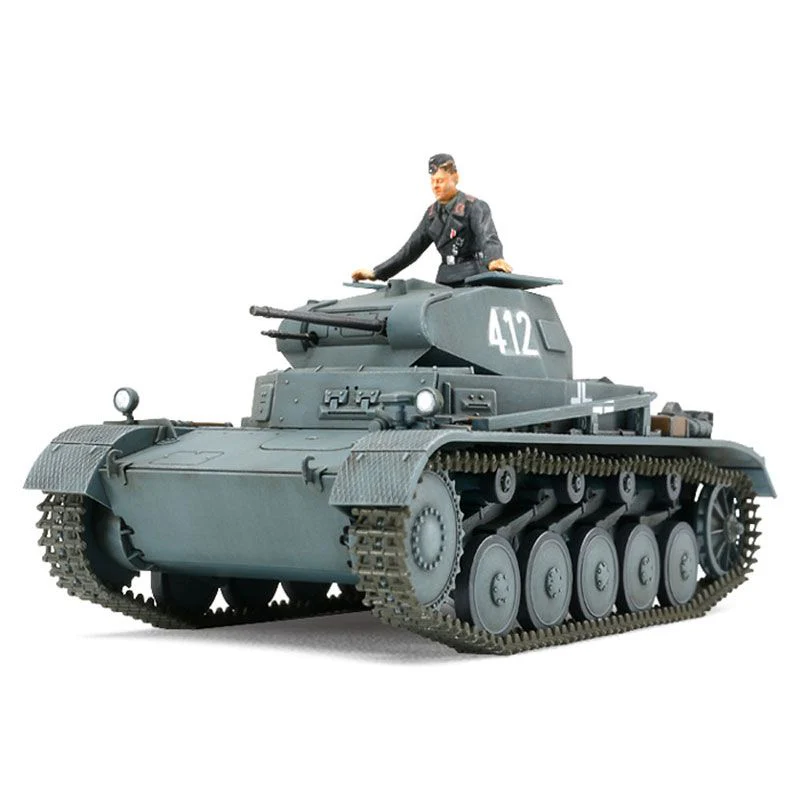
German Panzerkampfwagen II Ausf.A/B/C (French) 1/48 - Tamiya Scale Model Kit
Palm-Top Blitzer
The Panzer II Ausf.A/B/C variants were the mainstay tanks of the German Panzer Divisions during the Blitzkreig operations of early-WWII. They were compact (4.8m long, 2.2m wide) tanks equipped with a 140hp gasoline engine, which enabled a maximum speed of 40km/h. Although they were lightly armed with only a 2cm main gun and a 7.92mm machine gun and even their frontal armor was a mere 15mm thick, they provided valiant service during the Polish and French campaigns when the German Army had a shortage of the more capable Pz.Kpfw. III tanks. In particular, many Pz.Kpfw. IIs which saw combat in France were modified with extra frontal armor plating.
More Images
German Panzerkampfwagen II Ausf.A/B/C (French) 1/48 - Tamiya Scale Model Kit
Palm-Top Blitzer
The Panzer II Ausf.A/B/C variants were the mainstay tanks of the German Panzer Divisions during the Blitzkreig operations of early-WWII. They were compact (4.8m long, 2.2m wide) tanks equipped with a 140hp gasoline engine, which enabled a maximum speed of 40km/h. Although they were lightly armed with only a 2cm main gun and a 7.92mm machine gun and even their frontal armor was a mere 15mm thick, they provided valiant service during the Polish and French campaigns when the German Army had a shortage of the more capable Pz.Kpfw. III tanks. In particular, many Pz.Kpfw. IIs which saw combat in France were modified with extra frontal armor plating.
Product Information
Product Information
Shipping & Returns
Shipping & Returns
Description
Palm-Top Blitzer
The Panzer II Ausf.A/B/C variants were the mainstay tanks of the German Panzer Divisions during the Blitzkreig operations of early-WWII. They were compact (4.8m long, 2.2m wide) tanks equipped with a 140hp gasoline engine, which enabled a maximum speed of 40km/h. Although they were lightly armed with only a 2cm main gun and a 7.92mm machine gun and even their frontal armor was a mere 15mm thick, they provided valiant service during the Polish and French campaigns when the German Army had a shortage of the more capable Pz.Kpfw. III tanks. In particular, many Pz.Kpfw. IIs which saw combat in France were modified with extra frontal armor plating.