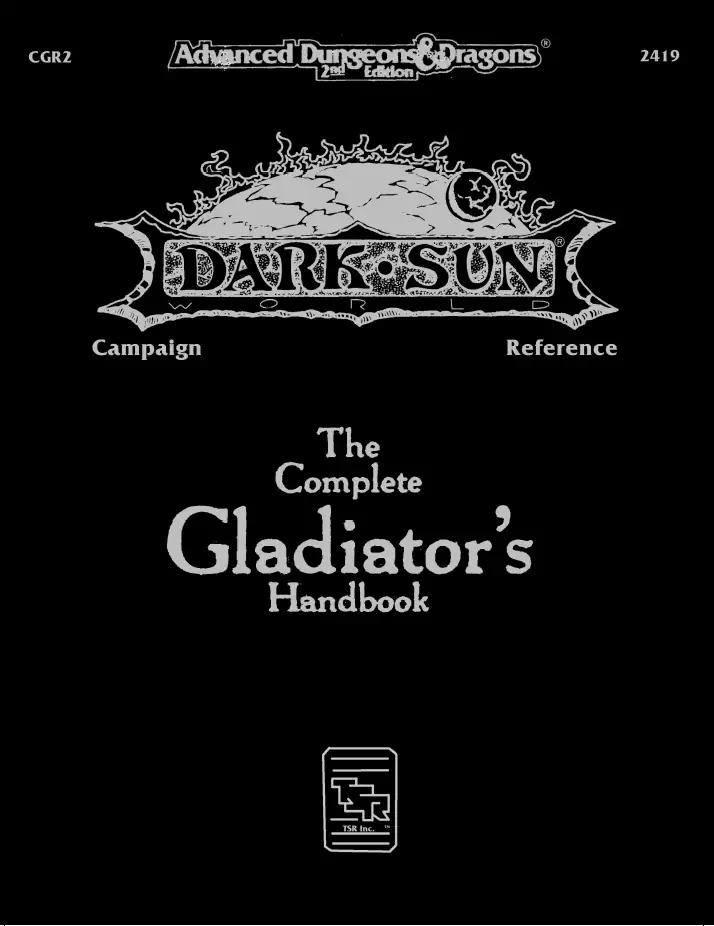
Dark Sun the Complete Gladiator's Handbook - AD&D 2nd Edition Dungeons & Dragons - Reprint Softcover
Dark Sun the Complete Gladiator's Handbook - AD&D 2nd Edition Dungeons & Dragons - Reprint Softcover
From the dusty arenas of Athas comes The Complete Gladiator's Handbook, ready to arm the fiercest Dark Sun campaign antagonist. Numerous new kits, details of the Tyr region's arenas, quick summaries of combat rules, a martial arts system, and suggestions on how to run arena games are within these pages. So gird your weapons-your opponents await!
Product History
CGR2: The Complete Gladiator's Handbook (1993), by Walter M. Baas and Colin McComb, is the second book in the "Campaign Guide Reference" series; it was published in June 1993.
Origins: A Second CGR. CGR1: The Complete Spacefarer's Handbook (1992) debuted the idea of creating crunchy splatbooks for D&D's various settings with a book full of Spelljammer (1989) races and kits. The Complete Gladiator's Handbook moves on to the Dark Sun (1991), but offers a much tighter scope: it focuses on a single sort of Dark Sun character, the gladiator, and also includes relevant rules and setting information.
One reason for this more limited scope may be that unlike many of the other D&D settings, Dark Sun was about to begin what would be an extended series of crunchy splatbooks, focusing on the various magic wielders of Athas: DSS2: "Earth, Air, Fire and Water" (1993), "The Will and the Way" (1994), and "Defilers and Preservers: The Wizards of Athas" (1996). The Complete Gladiators Handbook, with its martial focus, is a natural complement.
A History of Gladiators. Gladiators are popular in pulp fiction, so it's somewhat surprising that they barely made any appearances in D&D for a decade. There's one early exception, in The Dragon #3 (October 1976), which features gladiator as a level title for fighting women. However, it's really Dragon #73 (May 1983) that features the first notable inclusion. "The Duelist" appears as an NPC class; the gladiator is seen as a sort of early duelist and again appears as a level title, between "challenger" and "bladesmen".
Gladiators finally started to appear in adventures a few years later. DL12: "Dragons of Faith" (1986) and H2: "The Mines of Bloodstone" (1986) both feature arenas and gladiators to fill them, but only in minor roles. The Roman-based Thyatis would offer an more obvious home for gladiators starting in Dawn of the Emperors: Thyatis and Alphatia (1989), resulting in two gladiator-focused adventures: DDA1: "Arena of Thyatis" (1990) and DDA2: "Legions of Thyatis" (1990).
Meanwhile gladiators were offered as a player class for the first time in PHBR1: The Complete Fighter's Handbook (1989), which features a gladiator kit. However, it would be the Dark Sun Boxed Set (1991) that offered the best-ever look at gladiators in D&D, because they're one of the standard classes in the world of Athas, laid out as a warrior subclass.
i>Expanding D&D. The Gladiator's Handbook is full of gladiator kits and special gladiator abilities. It also features a full section on combat. This includes new rules for special attacks like disarm and shield-rush, which were all but unknown in AD&D 2e days, when fighters usually said "I hit the monster"; in addition, there are rules for bleeding, hit locations, and martial arts — all popular rules variants among fans over the years.
Exploring Athas. The Gladiator's Handbook includes looks at arenas throughout Dark Sun, including Balic, Draj, Gulg, Nibenay, Ram, Tyr, and Urik.
About the Creators. The credits are humorously written as: "Walter M. Baas (Character Creation and Arenas) and Colin McComb (the other stuff)".
About the Product Historian
The history of this product was researched and written by Shannon Appelcline, the editor-in-chief of RPGnet and the author of Designers & Dragons - a history of the roleplaying industry told one company at a time. Please feel free to mail corrections, comments, and additions to [email protected].
We (Wizards) recognize that some of the legacy content available on this website does not reflect the values of the Dungeons & Dragons franchise today. Some older content may reflect ethnic, racial, and gender prejudice that were commonplace in American society at that time. These depictions were wrong then and are wrong today. This content is presented as it was originally created, because to do otherwise would be the same as claiming these prejudices never existed. Dungeons & Dragons teaches that diversity is a strength, and we strive to make our D&D products as welcoming and inclusive as possible. This part of our work will never end.
Original: $30.00
-65%$30.00
$10.50Dark Sun the Complete Gladiator's Handbook - AD&D 2nd Edition Dungeons & Dragons - Reprint Softcover
From the dusty arenas of Athas comes The Complete Gladiator's Handbook, ready to arm the fiercest Dark Sun campaign antagonist. Numerous new kits, details of the Tyr region's arenas, quick summaries of combat rules, a martial arts system, and suggestions on how to run arena games are within these pages. So gird your weapons-your opponents await!
Product History
CGR2: The Complete Gladiator's Handbook (1993), by Walter M. Baas and Colin McComb, is the second book in the "Campaign Guide Reference" series; it was published in June 1993.
Origins: A Second CGR. CGR1: The Complete Spacefarer's Handbook (1992) debuted the idea of creating crunchy splatbooks for D&D's various settings with a book full of Spelljammer (1989) races and kits. The Complete Gladiator's Handbook moves on to the Dark Sun (1991), but offers a much tighter scope: it focuses on a single sort of Dark Sun character, the gladiator, and also includes relevant rules and setting information.
One reason for this more limited scope may be that unlike many of the other D&D settings, Dark Sun was about to begin what would be an extended series of crunchy splatbooks, focusing on the various magic wielders of Athas: DSS2: "Earth, Air, Fire and Water" (1993), "The Will and the Way" (1994), and "Defilers and Preservers: The Wizards of Athas" (1996). The Complete Gladiators Handbook, with its martial focus, is a natural complement.
A History of Gladiators. Gladiators are popular in pulp fiction, so it's somewhat surprising that they barely made any appearances in D&D for a decade. There's one early exception, in The Dragon #3 (October 1976), which features gladiator as a level title for fighting women. However, it's really Dragon #73 (May 1983) that features the first notable inclusion. "The Duelist" appears as an NPC class; the gladiator is seen as a sort of early duelist and again appears as a level title, between "challenger" and "bladesmen".
Gladiators finally started to appear in adventures a few years later. DL12: "Dragons of Faith" (1986) and H2: "The Mines of Bloodstone" (1986) both feature arenas and gladiators to fill them, but only in minor roles. The Roman-based Thyatis would offer an more obvious home for gladiators starting in Dawn of the Emperors: Thyatis and Alphatia (1989), resulting in two gladiator-focused adventures: DDA1: "Arena of Thyatis" (1990) and DDA2: "Legions of Thyatis" (1990).
Meanwhile gladiators were offered as a player class for the first time in PHBR1: The Complete Fighter's Handbook (1989), which features a gladiator kit. However, it would be the Dark Sun Boxed Set (1991) that offered the best-ever look at gladiators in D&D, because they're one of the standard classes in the world of Athas, laid out as a warrior subclass.
i>Expanding D&D. The Gladiator's Handbook is full of gladiator kits and special gladiator abilities. It also features a full section on combat. This includes new rules for special attacks like disarm and shield-rush, which were all but unknown in AD&D 2e days, when fighters usually said "I hit the monster"; in addition, there are rules for bleeding, hit locations, and martial arts — all popular rules variants among fans over the years.
Exploring Athas. The Gladiator's Handbook includes looks at arenas throughout Dark Sun, including Balic, Draj, Gulg, Nibenay, Ram, Tyr, and Urik.
About the Creators. The credits are humorously written as: "Walter M. Baas (Character Creation and Arenas) and Colin McComb (the other stuff)".
About the Product Historian
The history of this product was researched and written by Shannon Appelcline, the editor-in-chief of RPGnet and the author of Designers & Dragons - a history of the roleplaying industry told one company at a time. Please feel free to mail corrections, comments, and additions to [email protected].
We (Wizards) recognize that some of the legacy content available on this website does not reflect the values of the Dungeons & Dragons franchise today. Some older content may reflect ethnic, racial, and gender prejudice that were commonplace in American society at that time. These depictions were wrong then and are wrong today. This content is presented as it was originally created, because to do otherwise would be the same as claiming these prejudices never existed. Dungeons & Dragons teaches that diversity is a strength, and we strive to make our D&D products as welcoming and inclusive as possible. This part of our work will never end.
Product Information
Product Information
Shipping & Returns
Shipping & Returns
Description
From the dusty arenas of Athas comes The Complete Gladiator's Handbook, ready to arm the fiercest Dark Sun campaign antagonist. Numerous new kits, details of the Tyr region's arenas, quick summaries of combat rules, a martial arts system, and suggestions on how to run arena games are within these pages. So gird your weapons-your opponents await!
Product History
CGR2: The Complete Gladiator's Handbook (1993), by Walter M. Baas and Colin McComb, is the second book in the "Campaign Guide Reference" series; it was published in June 1993.
Origins: A Second CGR. CGR1: The Complete Spacefarer's Handbook (1992) debuted the idea of creating crunchy splatbooks for D&D's various settings with a book full of Spelljammer (1989) races and kits. The Complete Gladiator's Handbook moves on to the Dark Sun (1991), but offers a much tighter scope: it focuses on a single sort of Dark Sun character, the gladiator, and also includes relevant rules and setting information.
One reason for this more limited scope may be that unlike many of the other D&D settings, Dark Sun was about to begin what would be an extended series of crunchy splatbooks, focusing on the various magic wielders of Athas: DSS2: "Earth, Air, Fire and Water" (1993), "The Will and the Way" (1994), and "Defilers and Preservers: The Wizards of Athas" (1996). The Complete Gladiators Handbook, with its martial focus, is a natural complement.
A History of Gladiators. Gladiators are popular in pulp fiction, so it's somewhat surprising that they barely made any appearances in D&D for a decade. There's one early exception, in The Dragon #3 (October 1976), which features gladiator as a level title for fighting women. However, it's really Dragon #73 (May 1983) that features the first notable inclusion. "The Duelist" appears as an NPC class; the gladiator is seen as a sort of early duelist and again appears as a level title, between "challenger" and "bladesmen".
Gladiators finally started to appear in adventures a few years later. DL12: "Dragons of Faith" (1986) and H2: "The Mines of Bloodstone" (1986) both feature arenas and gladiators to fill them, but only in minor roles. The Roman-based Thyatis would offer an more obvious home for gladiators starting in Dawn of the Emperors: Thyatis and Alphatia (1989), resulting in two gladiator-focused adventures: DDA1: "Arena of Thyatis" (1990) and DDA2: "Legions of Thyatis" (1990).
Meanwhile gladiators were offered as a player class for the first time in PHBR1: The Complete Fighter's Handbook (1989), which features a gladiator kit. However, it would be the Dark Sun Boxed Set (1991) that offered the best-ever look at gladiators in D&D, because they're one of the standard classes in the world of Athas, laid out as a warrior subclass.
i>Expanding D&D. The Gladiator's Handbook is full of gladiator kits and special gladiator abilities. It also features a full section on combat. This includes new rules for special attacks like disarm and shield-rush, which were all but unknown in AD&D 2e days, when fighters usually said "I hit the monster"; in addition, there are rules for bleeding, hit locations, and martial arts — all popular rules variants among fans over the years.
Exploring Athas. The Gladiator's Handbook includes looks at arenas throughout Dark Sun, including Balic, Draj, Gulg, Nibenay, Ram, Tyr, and Urik.
About the Creators. The credits are humorously written as: "Walter M. Baas (Character Creation and Arenas) and Colin McComb (the other stuff)".
About the Product Historian
The history of this product was researched and written by Shannon Appelcline, the editor-in-chief of RPGnet and the author of Designers & Dragons - a history of the roleplaying industry told one company at a time. Please feel free to mail corrections, comments, and additions to [email protected].
We (Wizards) recognize that some of the legacy content available on this website does not reflect the values of the Dungeons & Dragons franchise today. Some older content may reflect ethnic, racial, and gender prejudice that were commonplace in American society at that time. These depictions were wrong then and are wrong today. This content is presented as it was originally created, because to do otherwise would be the same as claiming these prejudices never existed. Dungeons & Dragons teaches that diversity is a strength, and we strive to make our D&D products as welcoming and inclusive as possible. This part of our work will never end.