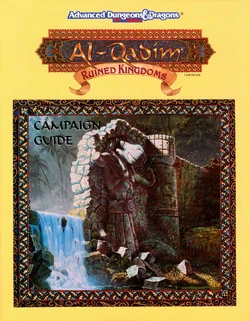
Al-Qadim Ruined Kingdoms - AD&D 2nd Edition Dungeons & Dragons - Reprint Softcover
Please note that the softcover book does not come with a foldout poster map. The digital version includes a PDF of the map divided so it can be printed on a home printer.
Unveil the forbidden secrets of Nog and Kadar!
The Nogaro River has seen the rise and gall of countless empires, unequaled in their evil and terror. Buried but not destroyed, their legacy lives on, shrouded by the tangled jungle and by time itself.
With Ruined Kingdoms, bold explorers can at last lift the veil of oblivion and unravel the mysteries of a dark and sinister past. Inside you'll discover:
- A 32-page campaign booklet describing the Ruined Kingdoms and their many secrets.
- A 64-page book packed with adventures-nine plots of intrigue and danger that transport player characters from Dihliz to Afyal and into the heat of the ruin-choked jungle. Adventurers face yak-men, genies, and giants, and unearth artifacts of awesome magical power.
- An 8-page booklet filled with villainous women and deadly reptilian monsters.
- Six cardstock sheets featuring detailed maps and player aids.
- A stunning poster map of eastern Zakhara, depicting the twisting valleys and ancient capitals of the Ruined Kingdoms.
Recommended for use with the Arabian Adventures rulebook.
Product History
Ruined Kingdoms (1994), by Steven Kurtz, is the fifth boxed supplement for Al-Qadim. It was published in January 1994.
About the Module Code. By early 1994, TSR had stopped using module codes, but Ruined Kingdoms is usually noted as ALQ5. The next three boxed Al-Qadim supplemented have similarly been recognized as ALQ6, ALQ7, and ALQ8.
Origins (I): Al-Qadim, Year Three. When Andria Hayday and Jeff Grubb proposed the Al-Qadim line, they intended it to have a very limited lifespan of just two years, with the option for a third year and then the option for a fourth, if TSR was so inclined. But, that would be the limit. TSR decided to pick up the line for its third year, and Ruined Kingdoms marks the start of that.
However, some fans feel that Al-Qadim's third year was weaker than the two that preceded it. Certainly, the ideas presented in that third year deviated further from the Arabian core of the line, and there was also some repetition.
Origins (II): More Boxes. Ruined Kingdoms matches the clean and specific organization of the "ALQ" line. That means it's a slim box containing a 32-page sourcebook, a 64-page adventure book, and a number of looseleaf sheets. The one big change in this box is that the 8 pages of looseleaf Monstrous Compendium entries have become an 8-page stapled booklet (which only contains a couple of pages of monsters, as it turns out).
This was a clear reflection of the changes in the Monstrous line itself. The looseleaf sheets had never worked and so had ended two months earlier with the publication of MC15: "Monstrous Compendium Ravenloft Appendix II: Children of the Night" (1993). However, it would still be half a year before bound books returned with the Mystara Monstrous Compendium (1994). Nonetheless, the monster booklet of Ruined Kingdoms was a sign of things to come.
Origins (III): Jungle Pulp Sources. The Arabian sources of the first four "ALQ" supplements had been front and forward, including famous stories about Sinbad, the Old Man in the Mountain, and of course One Thousand and One Nights.
Ruined Kingdoms is very different, instead offering up a pulp jungle tale that feels more like southeastern Asia than the Middle East. As such it marked a sea change, where Al-Qadim moved from being an Arabian setting to being a D&D setting that could be expanded and developed as its own entity. (With that said, there's still plenty of Arabian fables and magics here; it's just all placed in an unusual setting.)
Adventure Tropes. Ruined Kingdoms consists of a loose frame containing several individual adventures. These scenarios aren't connected, and only a few deal with the main plot. The adventures are typical for the '90s: some are event-driven while others focus on roleplaying. The few delves into tombs and ruins are brief.
Adventures Tropes: The Profit-Squeeze Monster. "Curse of the Serene Isle" is a heavy-handed "profit-squeeze monster", a trope hated by players. It boldly states: "Keep in mind that this mini-adventure is intended as a device for the DM to legitimately lighten the purses and reduce the hoards of magical items carried by all but exceptionally powerful parties."
Expanding D&D. Specialty priests packages are included for Geomancers and Regarran cultists.
Exploring Al-Qadim. The plan was for each "ALQ" supplement to extend the smaller-scale maps of Al-Qadim. Ruined Kingdoms offers a new poster map that reveals all of Eastern Zakhara, focusing on the ruined kingdoms of Nog and Kadar as well as the gateway city of Dihilz and the ancient cities of Kadarasto, Medina al-Afyal, and Rog'osto.
Monsters of Note. Jungles usually focus on snakes, and Ruined Kingdoms does include a few new serpents. However the major new monsters of this supplement are the segarrans, a group of crocodile people(!) who haven't been seen much since. If it seems like the yuan-ti are notably missing, they would appear in a Ruined Kingdoms delve in the next supplement, Cities of Bone (1994).
Organizations of Note. The Geomancers and the cult of Ragarra both get considerable attention, continuing Al-Qadim's focus on groups of this sort.
Future History. "Secrets of the Arch-Geomancer", by Paul Fraser in Dragon #250 (August 1998), returns to some of the background of this supplement.
About the Creators. Steven Kurtz was a major force in Al-Qadim in its last year. He authored both Ruined Kingdoms and Cities of Bone, then wrote what almost felt like the 14th supplement for Al-Qadim, DMGR7: The Complete Book of Necromancers (1995).
About the Product Historian
The history of this product was researched and written by Shannon Appelcline, the editor-in-chief of RPGnet and the author of Designers & Dragons - a history of the roleplaying industry told one company at a time. Please feel free to mail corrections, comments, and additions to [email protected].
We (Wizards) recognize that some of the legacy content available on this website does not reflect the values of the Dungeons & Dragons franchise today. Some older content may reflect ethnic, racial, and gender prejudice that were commonplace in American society at that time. These depictions were wrong then and are wrong today. This content is presented as it was originally created, because to do otherwise would be the same as claiming these prejudices never existed. Dungeons & Dragons teaches that diversity is a strength, and we strive to make our D&D products as welcoming and inclusive as possible. This part of our work will never end.
Al-Qadim Ruined Kingdoms - AD&D 2nd Edition Dungeons & Dragons - Reprint Softcover
Please note that the softcover book does not come with a foldout poster map. The digital version includes a PDF of the map divided so it can be printed on a home printer.
Unveil the forbidden secrets of Nog and Kadar!
The Nogaro River has seen the rise and gall of countless empires, unequaled in their evil and terror. Buried but not destroyed, their legacy lives on, shrouded by the tangled jungle and by time itself.
With Ruined Kingdoms, bold explorers can at last lift the veil of oblivion and unravel the mysteries of a dark and sinister past. Inside you'll discover:
- A 32-page campaign booklet describing the Ruined Kingdoms and their many secrets.
- A 64-page book packed with adventures-nine plots of intrigue and danger that transport player characters from Dihliz to Afyal and into the heat of the ruin-choked jungle. Adventurers face yak-men, genies, and giants, and unearth artifacts of awesome magical power.
- An 8-page booklet filled with villainous women and deadly reptilian monsters.
- Six cardstock sheets featuring detailed maps and player aids.
- A stunning poster map of eastern Zakhara, depicting the twisting valleys and ancient capitals of the Ruined Kingdoms.
Recommended for use with the Arabian Adventures rulebook.
Product History
Ruined Kingdoms (1994), by Steven Kurtz, is the fifth boxed supplement for Al-Qadim. It was published in January 1994.
About the Module Code. By early 1994, TSR had stopped using module codes, but Ruined Kingdoms is usually noted as ALQ5. The next three boxed Al-Qadim supplemented have similarly been recognized as ALQ6, ALQ7, and ALQ8.
Origins (I): Al-Qadim, Year Three. When Andria Hayday and Jeff Grubb proposed the Al-Qadim line, they intended it to have a very limited lifespan of just two years, with the option for a third year and then the option for a fourth, if TSR was so inclined. But, that would be the limit. TSR decided to pick up the line for its third year, and Ruined Kingdoms marks the start of that.
However, some fans feel that Al-Qadim's third year was weaker than the two that preceded it. Certainly, the ideas presented in that third year deviated further from the Arabian core of the line, and there was also some repetition.
Origins (II): More Boxes. Ruined Kingdoms matches the clean and specific organization of the "ALQ" line. That means it's a slim box containing a 32-page sourcebook, a 64-page adventure book, and a number of looseleaf sheets. The one big change in this box is that the 8 pages of looseleaf Monstrous Compendium entries have become an 8-page stapled booklet (which only contains a couple of pages of monsters, as it turns out).
This was a clear reflection of the changes in the Monstrous line itself. The looseleaf sheets had never worked and so had ended two months earlier with the publication of MC15: "Monstrous Compendium Ravenloft Appendix II: Children of the Night" (1993). However, it would still be half a year before bound books returned with the Mystara Monstrous Compendium (1994). Nonetheless, the monster booklet of Ruined Kingdoms was a sign of things to come.
Origins (III): Jungle Pulp Sources. The Arabian sources of the first four "ALQ" supplements had been front and forward, including famous stories about Sinbad, the Old Man in the Mountain, and of course One Thousand and One Nights.
Ruined Kingdoms is very different, instead offering up a pulp jungle tale that feels more like southeastern Asia than the Middle East. As such it marked a sea change, where Al-Qadim moved from being an Arabian setting to being a D&D setting that could be expanded and developed as its own entity. (With that said, there's still plenty of Arabian fables and magics here; it's just all placed in an unusual setting.)
Adventure Tropes. Ruined Kingdoms consists of a loose frame containing several individual adventures. These scenarios aren't connected, and only a few deal with the main plot. The adventures are typical for the '90s: some are event-driven while others focus on roleplaying. The few delves into tombs and ruins are brief.
Adventures Tropes: The Profit-Squeeze Monster. "Curse of the Serene Isle" is a heavy-handed "profit-squeeze monster", a trope hated by players. It boldly states: "Keep in mind that this mini-adventure is intended as a device for the DM to legitimately lighten the purses and reduce the hoards of magical items carried by all but exceptionally powerful parties."
Expanding D&D. Specialty priests packages are included for Geomancers and Regarran cultists.
Exploring Al-Qadim. The plan was for each "ALQ" supplement to extend the smaller-scale maps of Al-Qadim. Ruined Kingdoms offers a new poster map that reveals all of Eastern Zakhara, focusing on the ruined kingdoms of Nog and Kadar as well as the gateway city of Dihilz and the ancient cities of Kadarasto, Medina al-Afyal, and Rog'osto.
Monsters of Note. Jungles usually focus on snakes, and Ruined Kingdoms does include a few new serpents. However the major new monsters of this supplement are the segarrans, a group of crocodile people(!) who haven't been seen much since. If it seems like the yuan-ti are notably missing, they would appear in a Ruined Kingdoms delve in the next supplement, Cities of Bone (1994).
Organizations of Note. The Geomancers and the cult of Ragarra both get considerable attention, continuing Al-Qadim's focus on groups of this sort.
Future History. "Secrets of the Arch-Geomancer", by Paul Fraser in Dragon #250 (August 1998), returns to some of the background of this supplement.
About the Creators. Steven Kurtz was a major force in Al-Qadim in its last year. He authored both Ruined Kingdoms and Cities of Bone, then wrote what almost felt like the 14th supplement for Al-Qadim, DMGR7: The Complete Book of Necromancers (1995).
About the Product Historian
The history of this product was researched and written by Shannon Appelcline, the editor-in-chief of RPGnet and the author of Designers & Dragons - a history of the roleplaying industry told one company at a time. Please feel free to mail corrections, comments, and additions to [email protected].
We (Wizards) recognize that some of the legacy content available on this website does not reflect the values of the Dungeons & Dragons franchise today. Some older content may reflect ethnic, racial, and gender prejudice that were commonplace in American society at that time. These depictions were wrong then and are wrong today. This content is presented as it was originally created, because to do otherwise would be the same as claiming these prejudices never existed. Dungeons & Dragons teaches that diversity is a strength, and we strive to make our D&D products as welcoming and inclusive as possible. This part of our work will never end.
Product Information
Product Information
Shipping & Returns
Shipping & Returns
Description
Please note that the softcover book does not come with a foldout poster map. The digital version includes a PDF of the map divided so it can be printed on a home printer.
Unveil the forbidden secrets of Nog and Kadar!
The Nogaro River has seen the rise and gall of countless empires, unequaled in their evil and terror. Buried but not destroyed, their legacy lives on, shrouded by the tangled jungle and by time itself.
With Ruined Kingdoms, bold explorers can at last lift the veil of oblivion and unravel the mysteries of a dark and sinister past. Inside you'll discover:
- A 32-page campaign booklet describing the Ruined Kingdoms and their many secrets.
- A 64-page book packed with adventures-nine plots of intrigue and danger that transport player characters from Dihliz to Afyal and into the heat of the ruin-choked jungle. Adventurers face yak-men, genies, and giants, and unearth artifacts of awesome magical power.
- An 8-page booklet filled with villainous women and deadly reptilian monsters.
- Six cardstock sheets featuring detailed maps and player aids.
- A stunning poster map of eastern Zakhara, depicting the twisting valleys and ancient capitals of the Ruined Kingdoms.
Recommended for use with the Arabian Adventures rulebook.
Product History
Ruined Kingdoms (1994), by Steven Kurtz, is the fifth boxed supplement for Al-Qadim. It was published in January 1994.
About the Module Code. By early 1994, TSR had stopped using module codes, but Ruined Kingdoms is usually noted as ALQ5. The next three boxed Al-Qadim supplemented have similarly been recognized as ALQ6, ALQ7, and ALQ8.
Origins (I): Al-Qadim, Year Three. When Andria Hayday and Jeff Grubb proposed the Al-Qadim line, they intended it to have a very limited lifespan of just two years, with the option for a third year and then the option for a fourth, if TSR was so inclined. But, that would be the limit. TSR decided to pick up the line for its third year, and Ruined Kingdoms marks the start of that.
However, some fans feel that Al-Qadim's third year was weaker than the two that preceded it. Certainly, the ideas presented in that third year deviated further from the Arabian core of the line, and there was also some repetition.
Origins (II): More Boxes. Ruined Kingdoms matches the clean and specific organization of the "ALQ" line. That means it's a slim box containing a 32-page sourcebook, a 64-page adventure book, and a number of looseleaf sheets. The one big change in this box is that the 8 pages of looseleaf Monstrous Compendium entries have become an 8-page stapled booklet (which only contains a couple of pages of monsters, as it turns out).
This was a clear reflection of the changes in the Monstrous line itself. The looseleaf sheets had never worked and so had ended two months earlier with the publication of MC15: "Monstrous Compendium Ravenloft Appendix II: Children of the Night" (1993). However, it would still be half a year before bound books returned with the Mystara Monstrous Compendium (1994). Nonetheless, the monster booklet of Ruined Kingdoms was a sign of things to come.
Origins (III): Jungle Pulp Sources. The Arabian sources of the first four "ALQ" supplements had been front and forward, including famous stories about Sinbad, the Old Man in the Mountain, and of course One Thousand and One Nights.
Ruined Kingdoms is very different, instead offering up a pulp jungle tale that feels more like southeastern Asia than the Middle East. As such it marked a sea change, where Al-Qadim moved from being an Arabian setting to being a D&D setting that could be expanded and developed as its own entity. (With that said, there's still plenty of Arabian fables and magics here; it's just all placed in an unusual setting.)
Adventure Tropes. Ruined Kingdoms consists of a loose frame containing several individual adventures. These scenarios aren't connected, and only a few deal with the main plot. The adventures are typical for the '90s: some are event-driven while others focus on roleplaying. The few delves into tombs and ruins are brief.
Adventures Tropes: The Profit-Squeeze Monster. "Curse of the Serene Isle" is a heavy-handed "profit-squeeze monster", a trope hated by players. It boldly states: "Keep in mind that this mini-adventure is intended as a device for the DM to legitimately lighten the purses and reduce the hoards of magical items carried by all but exceptionally powerful parties."
Expanding D&D. Specialty priests packages are included for Geomancers and Regarran cultists.
Exploring Al-Qadim. The plan was for each "ALQ" supplement to extend the smaller-scale maps of Al-Qadim. Ruined Kingdoms offers a new poster map that reveals all of Eastern Zakhara, focusing on the ruined kingdoms of Nog and Kadar as well as the gateway city of Dihilz and the ancient cities of Kadarasto, Medina al-Afyal, and Rog'osto.
Monsters of Note. Jungles usually focus on snakes, and Ruined Kingdoms does include a few new serpents. However the major new monsters of this supplement are the segarrans, a group of crocodile people(!) who haven't been seen much since. If it seems like the yuan-ti are notably missing, they would appear in a Ruined Kingdoms delve in the next supplement, Cities of Bone (1994).
Organizations of Note. The Geomancers and the cult of Ragarra both get considerable attention, continuing Al-Qadim's focus on groups of this sort.
Future History. "Secrets of the Arch-Geomancer", by Paul Fraser in Dragon #250 (August 1998), returns to some of the background of this supplement.
About the Creators. Steven Kurtz was a major force in Al-Qadim in its last year. He authored both Ruined Kingdoms and Cities of Bone, then wrote what almost felt like the 14th supplement for Al-Qadim, DMGR7: The Complete Book of Necromancers (1995).
About the Product Historian
The history of this product was researched and written by Shannon Appelcline, the editor-in-chief of RPGnet and the author of Designers & Dragons - a history of the roleplaying industry told one company at a time. Please feel free to mail corrections, comments, and additions to [email protected].
We (Wizards) recognize that some of the legacy content available on this website does not reflect the values of the Dungeons & Dragons franchise today. Some older content may reflect ethnic, racial, and gender prejudice that were commonplace in American society at that time. These depictions were wrong then and are wrong today. This content is presented as it was originally created, because to do otherwise would be the same as claiming these prejudices never existed. Dungeons & Dragons teaches that diversity is a strength, and we strive to make our D&D products as welcoming and inclusive as possible. This part of our work will never end.